Texture Design for Diverse Virtual Touch Sensations: Perceptual Breadth of Parameter-Driven Turing Patterns

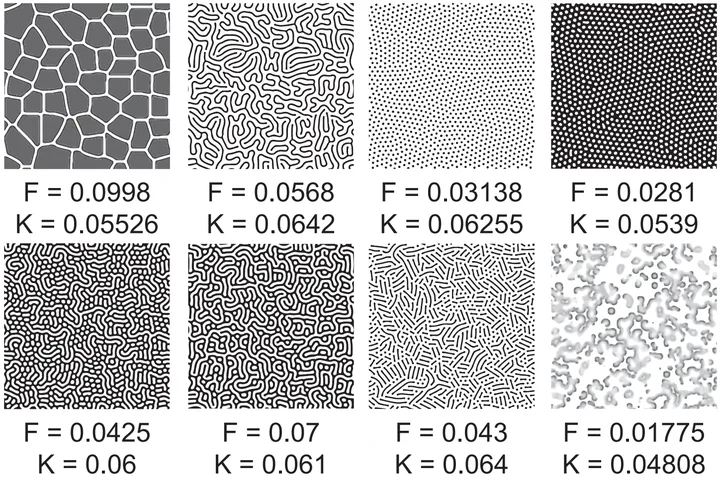 Reaction Diffusion Textures
Surface haptic technology reintegrates the sense of touch into virtual interactions on touchscreen devices, enhancing social interactions, educational tools, and daily screen tasks. Despite its clear benefits, this technology remains niche, and guidelines for designing diverse and compelling touch sensations are lacking. The ability to easily generate content and the existence of an established library of unique sensations and interactions may make the adoption of this technology more appealing to the average touchscreen user and for a broader range of mainstream applications. This study looks at the potential for parameter-driven reaction-diffusion algorithms to generate distinct, user-adjustable, and responsive texture stimuli.
Our user study investigating the distinguishability of a representative set of reaction-diffusion textures found potential for these textures in virtual texture spaces when using a friction-modulating display as the delivery platform, as perceived dissimilarity when using virtual tactile feedback has a strong association with the Feed Rate control parameter. This parameter strongly affected perception of dissimilarity for real 3-D printed textures \textit{and} virtual textures, suggesting that Turing patterns are suitable for diverse and intentional texture generation for other haptic surface display types (e.g. shape displays).
These results can inform how reaction-diffusion algorithms can be best leveraged to contribute to visual or tactile texture generation pipelines and spaces.